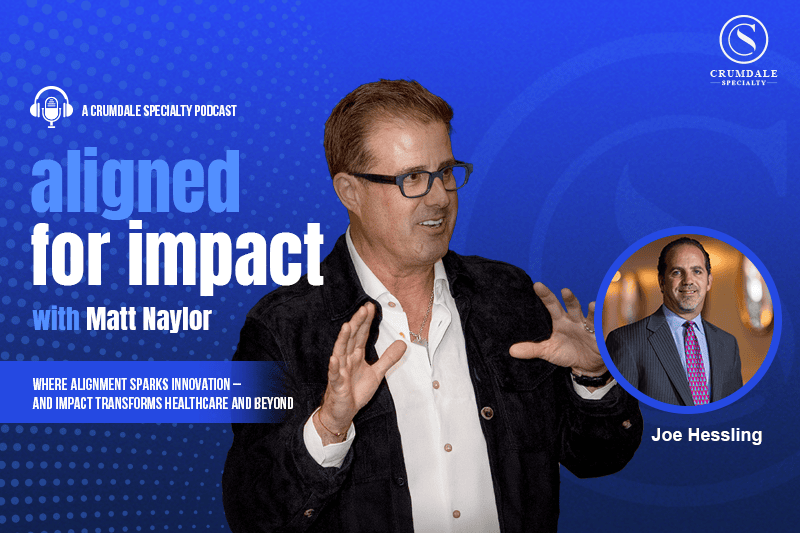
Matthew Naylor: Welcome to Align for Impact. I’m your host, Matthew Naylor. I started this podcast because healthcare and leadership both come down to the same thing: alignment. When people, purpose, and performance connect, real impact happens. On this show, we’ll talk with entrepreneurs, brokers, and change makers who are challenging what is broken in healthcare and in business and find new ways to make a difference for companies, communities, and the people they serve. So, Joe, welcome to the show. I’m Matt Naylor, and I’m the host. Alignment and impact are a big thing with me in my life and I’m really looking forward to our conversation today. You know, Joe, you are the CFO of Parcels out in Wilmington, Delaware. My bad.
Joe Hessling: We’re close.
Matthew Naylor: I would love to know, Joe, just where’d you grow up? How’d you get started? How’d you build your career?
Joe Hessling: Yeah. So I grew up in a tiny town in northeast Pennsylvania—Carbondale, Pennsylvania.
Matthew Naylor: I love Carbondale.
Joe Hessling: I grew up there. My entire childhood was there. I went to college in northeast Pennsylvania at King’s College. When I graduated school, I worked up in the Scranton area and realized that there were not a lot of opportunities up there for young guys like me. So I started looking around and I came down to Wilmington, Delaware. I did public accounting for about 18 years. I found a great opportunity for me to get out of public accounting and go into the corporate world, and was lucky enough to meet Jim and Maureen Johnson, who gave me the opportunity to come into Parcels and be their controller and take over their financials. I’ve been there ever since for 17 years.
Matthew Naylor: 17 years. Tell me a little bit, Joe. You know, Crumdale’s specialty is providing some very unique and distinctive services and solutions around level-funded, self-funded, and captives for self-insured employers. Tell me a little bit about your experience at Parcels. Tell us about the business.
Joe Hessling: So Parcels is—we get this question all the time—what does Parcels do? Myself and my fellow owners always have a difficult time answering because we do so many things. We’re a client service-based organization. We take care of lawyers, corporate lawyers, corporations, and the courts in Wilmington, Delaware. Delaware is really the corporate capital of the country where most Fortune 500 companies are incorporated because of their chancery court and favorable business rules. So when they have litigation, those litigations have to happen in Wilmington. Parcels started as a hand-delivery courier business 40 or 45 years ago. Jim started with five people just hand-delivering from lawyer to lawyer and court to lawyer. It grew to what it is today; now we are an electronic discovery business, a forensic e-discovery business, providing trial support, trial production, and witness binders for the courts. Revenue went from $2 million to almost $25 or $30 million today. We really grew with technology as law firms had to grow to handle their cases.
Matthew Naylor: And Joe, how many teammates or employees do you have in the company?
Joe Hessling: Right now, we have about 110 employees.
Matthew Naylor: 110 employees. Healthcare in this country is broken and has been for a long time. I’ve had the good fortune of having a bird’s-eye view into it for the last 30 years. There are not a lot of great solutions out there in the marketplace. You’re in Delaware, and I’m sure there’s an Aetna solution, a Cigna solution, or a Blue Cross solution. Not that they’re bad companies, but small employers don’t have great choices or access to data. It’s very opaque, and the lack of transparency is a big problem. As a CFO, I’m sure you have a perspective on how you manage this big line-item expense. Can you describe what you were doing year-over-year at Parcels to manage and mitigate your health insurance before working with Crumdale?
Joe Hessling: Sure. Every October or November, I knew what was coming. We would talk to our broker, who was a partner of yours at USI, and I’d be waiting to hear what our increase was going to be in the fully insured market. It became very frustrating. As a service-based organization, our biggest asset is our people. Almost 50% of our total revenue goes to taking care of our people, and healthcare is one of the biggest costs for that. Providing great quality healthcare is important to us because Parcels is a family. The increasing frustration in dealing with the big carriers became too much. Buzzy presented us with the level-funded model that you guys developed two or three years ago, and it worked great. That gave us the confidence to join the captive program. I’ve been in a captive for P&C for 13 years, so I know how it works. If we can make this work for healthcare, it’s a win-win.
Matthew Naylor: When you were fully insured, Joe, you weren’t getting a lot of data. For 17 years, the broker shows up with good intentions but just passes along increases. As a CFO, you have choices: does the company bear the burden or do you change deductibles and co-pays to pass the cost to the employees? I’m assuming that was really frustrating.
Joe Hessling: It really was. I’ll tell you this: this is the first year in my 17 years at Parcels that we did not increase our employees’ contribution to the health plan. It’s the first time, because of the model you guys presented, that it made sense to keep everything the same. The costs were similar to the previous year and there wasn’t an increase. Even better, we didn’t have to change our plan design or the cards; everything was seamless. The biggest thing to me is data. Data is an asset. We see the claim amounts now. The more data you get, the more you can help adjudicate claims because you’re saving dollars for yourself and your employees.
Matthew Naylor: At Crumdale, we have this very intentional, methodical approach to taking an employer like Parcels from fully insured to level-funded. Can you share a little about that experience?
Joe Hessling: Yeah, sure. As I said, we had looked at the captive model years ago but could never find a fit. It was frustrating to sit down with a broker and be told you have a 17% increase with no idea why. Moving to the level-funded model gave us the data. You meet with your broker monthly or quarterly to see what claims look like, so you have predictability. Finally moving into the captive, where I see bills weekly, I know where the claims are going and where the dollars are spent. It helps me financially; if someone is really sick or has an issue, I know where those costs are coming from. I have conversations with Buzzy or my broker to help adjudicate those and make sure employees are taken care of.
Matthew Naylor: And Joe, how did you make the decision to go from our level-funded solution into our high-performing captive?
Joe Hessling: That was really easy. Since I’ve been part of a P&C captive for years, I know the model. I didn’t know exactly how it worked healthcare-wise, but I knew the ultimate outcome. Being able to see the data and have transparency allows us to make decisions. I’m part of something bigger now. It’s about risk-taking and ownership.
Matthew Naylor: That’s awesome. At Crumdale, we focus on clients for a lifetime and aspire to set a new standard for the experience of a CFO, an owner, or a member. Can you speak to how we’ve delivered that standard in client services?
Joe Hessling: Yeah, sure. The biggest investment you guys have made, which I really appreciate, is the great people you have. It’s a partnership. We look at this as a long-term investment with Crumdale and a long-term investment in our employees to make their lives better.
Matthew Naylor: Joe, how does the Crumdale team show up every day? No business is perfect, but healthcare can be frustrating when you call a 1-800 number and nobody responds. How do you feel we show up as an organization to solve problems for you?
Joe Hessling: I think I deal with your people at Crumdale more than any other vendor on a weekly basis, and that’s a good thing for me. I deal with Nicoletta probably two or three times a week. I deal with Buzz. I met Jim Anders down here; Jim called me two weeks ago to say he’s part of the executive team and if I need someone to contact to get something done, he’s there. It’s about building relationships. Our business is built on client relationships, and I feel the same way about Crumdale. I met Tanya; everyone has been great and they care about Parcels, which is important to me.
Matthew Naylor: There’s a deep conviction to setting a new standard. What I love hearing you say is that you went from fully insured to level-funded to a high-performing captive, and for the first time in years, you didn’t have to pass along a big increase to your employees. How does that make you feel as a CFO?
Joe Hessling: It makes me feel great. There’s predictability. I know what our costs are. As I said earlier, one of our biggest costs is taking care of employees, and health insurance is part of that. We are very generous in our employer contribution. To be able to say I know what my costs are going to be without changing benefits is a big deal for our employees given the way things are in the world today.
Matthew Naylor: Joe, your partnership with us at Crumdale is amazing. Where do you see this relationship going five years from now?
Joe Hessling: I know our relationship is only going to be stronger because it’s already strong. Parcels is in it for the long haul. I know from experience that we’re going to be taken care of. You guys are building something special in the healthcare world and it’s exciting to be a part of it.
Matthew Naylor: Thanks, Joe. I appreciate the time and look forward to continuing the partnership.
Joe Hessling: Appreciate it.
Matthew Naylor: This is Matthew Naylor. You’ve been listening to Align for Impact.