

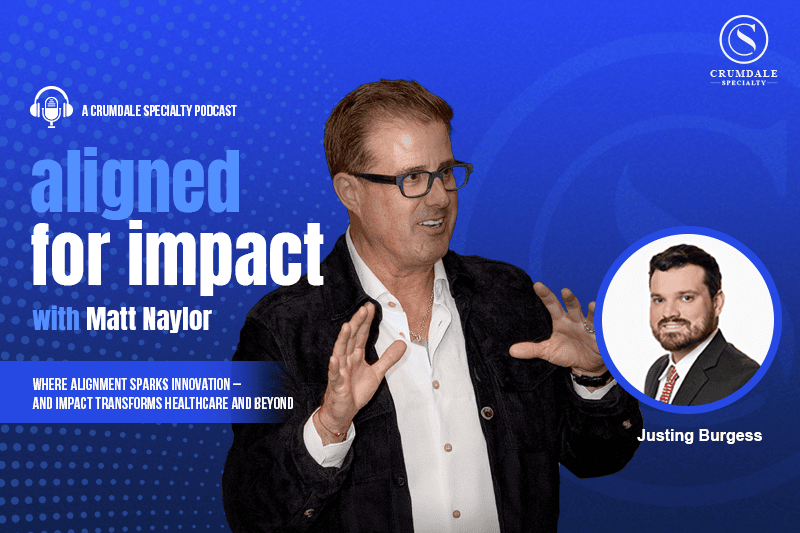
Rebuilding Healthcare With Resilience, Advocacy and Purpose ft. Justin Burgess
In this episode of Aligned for Impact, Matt Naylor sits down with Justin Burgess to explore how resilience, service, and transparency shape effective leadership in healthcare. Justin shares his journey from growing up in a family run restaurant business in New Orleans to becoming a leading voice in self insured employee benefits, including how experiences with Hurricane Katrina and the BP oil spill shaped his grit and servant leadership mindset. The conversation dives into fixing misalignment in healthcare through transparency, fiduciary responsibility, pharmacy cost containment, and human centered advocacy. Justin also reflects on entrepreneurship, culture, and the importance of doing hard things daily as a way to drive meaningful impact for employers and employees alike.
Listen on: Apple | Spotify | Amazon Music
About Aligned for Impact with Matthew Naylor
Healthcare in America is complex—and real change requires alignment.
Aligned for Impact with Matt Naylor explores what happens when vision, values, and execution come together across the ecosystem of healthcare, leadership, and business.
Hosted by entrepreneur and Crumdale founder Matt Naylor, this show brings together voices from across the industry—brokers, consultants, innovators, and leaders—who are driving better outcomes, lower costs, and improved experiences for employers and members alike.
But the conversations go beyond benefits. Matt dives into the principles of alignment that create lasting impact: emotional intelligence in leadership, trust in partnerships, purpose in culture, and a shared commitment to doing things the right way—not just the usual way.
It’s about the alignment that fuels innovation—and the impact that leaves a legacy.
Matthew Naylor: Welcome to Alignment for Impact. I’m your host, Matthew Naylor. I started this podcast because healthcare and leadership both come down to the same thing: alignment. When people, purpose, and performance connect, real impact happens. On this show, we’ll talk with entrepreneurs, brokers, and change-makers who are challenging what is broken in healthcare and in business to find new ways to make a difference for companies, communities, and the people they serve. Welcome back to the show. Today, I’m excited to welcome someone who has really been shaking things up around self-insured health plans. He is an amazing employee benefits consultant and the host of his own podcast. His story is great—once running the floor of a family-run business in the restaurant industry in New Orleans, he is now making a real impact for employee benefit health plans around the nation. His story is filled with passion, purpose, and joy. Please welcome Justin Burgess. Justin, I love icebreakers to start a conversation. When I started to learn about you, what struck me was your time in the restaurant business with your family in New Orleans. How did that all start for you? Justin Burgess: Yes, it was a family business called Sid-Mar’s Restaurant. My grandfather was Sidney and my grandmother was Mary Ann—that’s how they put it together. I was around 12 to 15 years old when the business was at its height. I just got addicted to spending time with family, having a sense of responsibility, and obviously having some cash at a young age. I always loved that time with my father. Matthew Naylor: Being in a family-run business can be rewarding but also challenging. Transitioning from the restaurant industry to employee benefits had to be a huge shift. What did you learn on the family side of the business that helped you transition into this field? Justin Burgess: I think I learned that things go wrong and you have to react. In New Orleans, hurricanes are frequent. If our freezers go out with all the food, that’s our cash—we didn’t have investors. I remember going there during hurricanes to ensure the generators were filled with gas. You learn to make things happen and you don’t say “no” to anything. If you have to stay until 2:00 AM, you do it. My father has a “picking up the trash” mentality. Even though I’m a producer now, at the end of the day, I’m a servant to my clients. I don’t just hold a title; if a client needs me to call a provider for them, I’m going to do it. It’s the same way my father would walk around the restaurant picking up trash every single day. Matthew Naylor: What I’m hearing resonates so much: no options, no excuses. Do whatever it takes to serve the client the right way. Justin Burgess: Exactly. We’re all in the service business, whether we like it or not. Whether you are serving brokers, customers, or restaurant guests, it’s all service. Matthew Naylor: How did you eventually transition out of the family business and into insurance? That’s a major inflection point. Justin Burgess: It was a crazy story. We were on the lakefront, and Hurricane Katrina wiped our building down to the pilings; we had nothing left. After that, we were in a ten-year battle with the state over eminent domain and property seizure. During that period, my father wanted to try again. We opened another location right when the BP oil spill happened. We had success for 30 years, lost it in Katrina, regained it, and then hit the oil spill. During all that, I was in college trying to be my own independent person while coming back on weekends to help. I saw my family at the highest and lowest points of their lives within a decade. Matthew Naylor: That experience clearly shaped your resiliency. How did that help you become the person you are today? Justin Burgess: That’s just New Orleans people; we have a “rebuild” mentality. I just left Jazz Fest—got a little sunburnt—but we love the culture. We deal with the hurricanes and the streets not being fixed because we are resilient. During Katrina, my wife lost everything. We lived on a second story, so we only lost our bottom floor. You had small businesses just figuring things out. Even from a broker standpoint, it was a crazy point in the marketplace where you still had to service clients while carriers were doing premium holidays. Matthew Naylor: When was your actual entry point into insurance and employee benefits? Justin Burgess: 2014. I was fresh out of college and applied to a random job online. I didn’t even really know what insurance was. I had friends getting into Northwestern Mutual, but I didn’t understand health insurance. I’m glad I found it because it taps into that customer service passion. If my kid asks for a summer job, I’m going to tell them to bartend or wait tables—do something where you have to talk to people. In fact, two of my current clients used to sit at the bar where I bartended back when I had no clue how to make drinks! Matthew Naylor: What did you start selling first? What you do today seems very different from where you began. Justin Burgess: I got in right around the technology boom. It wasn’t an insurance play initially; it was a straight administration play. The business has evolved. Back then, people just wanted things to work better administratively with tools like Ease or Employee Navigator. Now, I don’t even talk about benefit admin as a differentiator. Now it’s about what you can do on the specialty drug side and how you solve claim problems. Every broker has the tech, but not every broker understands the side of the equation. Matthew Naylor: Redefining health insurance is difficult. It’s a complicated ecosystem. I’ve heard you speak vocally about transparency and fiduciary responsibility. Can you tell us about your approach to that? Justin Burgess: It starts with a simple question: what is the average salary of your population? We sit at the table making good money, yet we make decisions for people earning $40,000 to $45,000 a year. We shouldn’t be leaving them with $5,000 deductibles and hundreds of dollars in drug costs. Step one is giving people access to a product that helps with their biggest ticket items—their monthly medications. I’ve seen what Crumbdale has done for my groups regarding Biosimilars. I had an HR director text me saying I saved her $300 a month on her own drugs. We are all fed up with these costs. We need to fix the problem of vendors hiding money and be transparent with employees about solutions to get their drugs elsewhere. Matthew Naylor: We know healthcare is complicated. What are you doing to drive the lowest net cost while creating a better experience for members? Justin Burgess: The low-hanging fruit is the Rx stuff—that’s a gimme. But you also have to pair it with advocacy. Brokers want to be transparent, but employees don’t necessarily want to talk to me. I know how to “finagle” healthcare, but not like a Crumbdale advocate who has quality metrics on every provider in the area. Giving people those tools is vital. When a drug gets denied due to a system glitch, having a team that responds quickly is what matters most to my clients. Matthew Naylor: PBMs have been getting a bad rap lately. While they are part of the solution, high-deductible plans and specialty drugs like GLP-1s are driving massive costs. What are you doing to impact those pharmacy costs? Justin Burgess: I’d start with Direct Primary Care (DPC). It gets people to a doctor faster. I’ll share my personal experience: I lost 50 pounds using GLP-1 drugs. My normal doctor just told me to “eat healthy.” I went and hired a cash-pay doctor for a full panel, and he found my Testosterone was low and my A1C was off the charts. He told me I was headed toward being diabetic. I took the medication for a year and a half and have since maintained a healthy lifestyle. Giving people access to a doctor who actually cares—and isn’t just a “pencil pusher” because the system only gives them 15 minutes—changes everything. An employee making $40,000 doesn’t want to spend $100 on urgent care or $300 for a specialist on a high-deductible plan. They only choose those plans because it’s $10 a paycheck versus $100, not because they like the deductible. Matthew Naylor: At the start of every plan year, we see members facing massive out-of-pocket costs. Is there anything your firm is doing to help drive that cost out of the system? Justin Burgess: I’m not a big high-deductible plan guy. I like using HRAs to provide employer money that helps subsidize those costs. When you pair an HRA or MERP with cost containment solutions, you can take care of high-cost specialty medications with partners like Crumbdale and Welldyne. Matthew Naylor: Are you doing anything unique around patient assistance programs that avoids disrupting the member? Justin Burgess: In the last six months, I’ve started calling employees personally to give them a sense of comfort that the process is legit. Often, they’ve worked for larger employers who were already doing this, so they aren’t as surprised. The market—with the Amazons and Mark Cubans of the world—is already telling people they can get drugs cheaper elsewhere. Matthew Naylor: We see a lot of “point solution fatigue” among employers and brokers. How are you helping your customers navigate the sea of AI, data, and new tech? Justin Burgess: I’m having fatigue as well! I’ve even posted on LinkedIn about it. It’s getting to be too many partners to handle. I believe we can solve this by just giving people advocates—real human beings. I love communicating via apps, but if my kid has an expensive drug, I want to talk to a person who has dealt with that situation multiple times before. When something happens to me personally, I’m just a freaked-out dad, not a “benefits expert.” We need to give people fewer apps and more human advocacy. Matthew Naylor: That’s awesome, Justin. In closing, as an entrepreneur, what does culture and leadership mean to you? Justin Burgess: You can be an entrepreneur inside someone else’s business. If you’re a salesperson, treat it like you own the company because clients are buying from you. I also believe that if you want to do something hard in business, you should do something hard in your personal life. I’m currently doing a 30-day challenge where I run a mile with a 20-pound weighted vest on an assault bike. I did it at 2:00 AM this morning. I want to show my clients that I’m doing something hard every day so that when it comes time to change their health plan, they know I’m ready for the challenge. Matthew Naylor: You’re a family man and you serve your customers the right way. What brings you the most joy and drives your purpose right now? Justin Burgess: It’s the messages I get on LinkedIn from people saying, “Keep it up.” When I go to my high school reunion and people think I’m “killing it,” I tell them I’m just an average guy with a camera. But the market sees me as someone who is out there hustling. Every employer client I work with, like my RV dealers who started with one location and now have 15, has that “grit” mentality. Matthew Naylor: I love that word—grit. It’s the one thing you aren’t born with. What advice would you give someone to live a life of impact? Justin Burgess: Find a mentor. Sean Torres with Intellicom is one of my mentors and clients. When I called him to ask what I should do, he said “Jump.” I said yes. If I hadn’t talked to him, I probably would have taken the easy path and a cushioned salary job. I decided to bet on myself instead. Matthew Naylor: You certainly aren’t the “cushy” type. You’re a high achiever making a real impact on healthcare. Justin, it’s been a real pleasure. Thank you for joining us today. Justin Burgess: Thank you. Appreciate it. Matthew Naylor: This is Matthew Naylor. You’ve been listening to Aligned for Impact.