
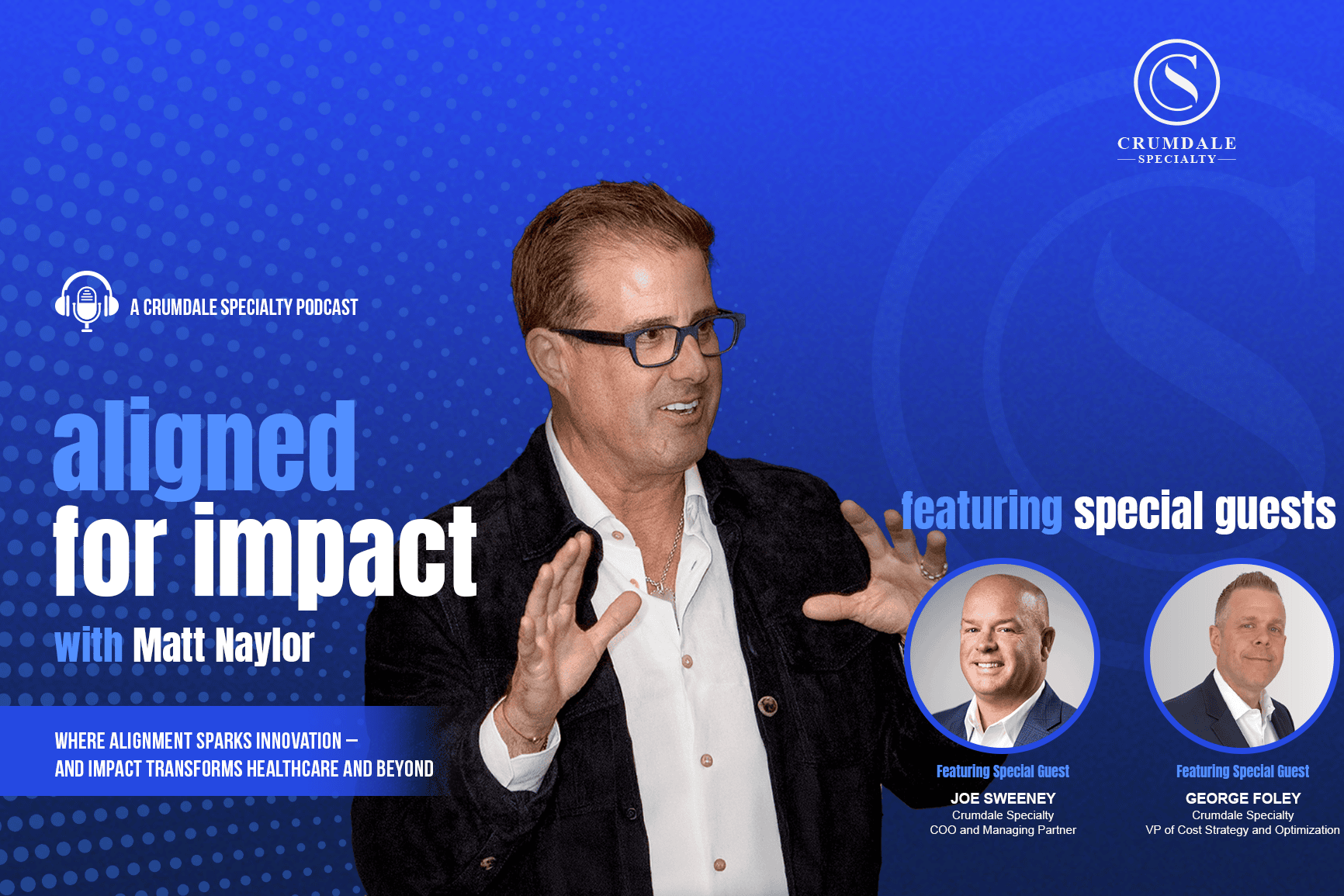
Connecting the Dots in Healthcare Cost Containment with Joe Sweeney and George Foley
On this episode, Matt Naylor is joined by Joe Sweeney and George Foley of Crumdale Specialty to discuss the challenges of healthcare cost containment and the need for a more connected approach to self-funded healthcare. Drawing on decades of experience across insurance, clinical care, stop loss, and healthcare strategy, Joe and George explore how fragmentation, misaligned incentives, and disconnected solutions can make it difficult for employers to effectively manage costs. The conversation explores how Crumdale is bringing together data, clinical intelligence, member advocacy, and cost containment strategies to identify opportunities earlier, improve member engagement, and create better outcomes for employers, brokers, and members.
Listen on: Apple | Spotify | Amazon Music
About Aligned for Impact with Matthew Naylor
Healthcare in America is complex—and real change requires alignment.
Aligned for Impact with Matt Naylor explores what happens when vision, values, and execution come together across the ecosystem of healthcare, leadership, and business.
Hosted by entrepreneur and Crumdale founder Matt Naylor, this show brings together voices from across the industry—brokers, consultants, innovators, and leaders—who are driving better outcomes, lower costs, and improved experiences for employers and members alike.
But the conversations go beyond benefits. Matt dives into the principles of alignment that create lasting impact: emotional intelligence in leadership, trust in partnerships, purpose in culture, and a shared commitment to doing things the right way—not just the usual way.
It’s about the alignment that fuels innovation—and the impact that leaves a legacy.
[00:00:03] Speaker A: Welcome to Align for Impact. I’m your host, Matthew Naylor. I started this podcast because healthcare and leadership both come down to the same thing. Alignment.
When people, purpose and performance connect, real impact happens.
On this show, we will talk to entrepreneurs, brokers and change makers who are challenging what is broken in health care and in business and find new ways to make a difference for companies, communities and the people we serve.
Joe George, welcome to the show. I really love having you here today. Talk about cost containment around self insured employers and employer health, but I love starting the show with like we’re about alignment and impact and the first place I like to really start is just getting to know you. So maybe, Joe, I’ll start with yourself. Where are you from? How’d you get into the industry? How’d you end up at Crumdale Specialty?
[00:01:06] Speaker B: Yeah. So born and raised in Philadelphia, graduated College in the mid-90s from Penn State. Began my career as a CPA of all things.Worked in public accounting, some industry, some consulting, and wound up in the insurance space in 2001 working for a large broker in Philadelphia. And that’s really where my insurance career started.
And then met you in 2007, came to work for you in 2008 and started my, you know, long journey into understanding, you know, health care, health care delivery, stop loss, insurance, reinsurance and all those things. It’s been a great journey.
[00:01:44] Speaker A: Great, thanks. Joe George, how about yourself? Where are you from? How’d you get into the business? [00:01:48] Speaker C: Yeah, so like Joe, I’m a, I’m a city guy, born and raised in Roxburgh. I like to give Jim Andrews a tough love. [00:01:55] Speaker A: That authentic Philadelphia accent, it comes out, [00:01:58] Speaker C: it comes out all the time. It’s real. [00:02:00] Speaker A: The people around the world are going to be listening to this and they need to understand, like, that is an authentic Philadelphia accent. [00:02:07] Speaker C: So I used to work at AstraZeneca’s Medical Information center and I would talk to patients from all around the country and without fail, people would say, are you from Philadelphia? They knew the accent. So, yep, born and raised in Philadelphia, left Philadelphia to go to high school at the time Rome was going to close, so I ended up at Archbishop Carroll, which really changed my trajectory. And I’m a registered nurse by training. Did a lot of different things in the healthcare sandbox. 30 years in healthcare. I worked at Thomas Jefferson, I worked in pharma, I sold medical devices, worked for Series A company selling software.And probably in 2011, Joe and I hooked up and I started to do work for elite and reviewing groups and ever since 2011, we stayed in touch. And in September, I guess, summertime, Joe reached out and said, hey, listen, we’re ready to go.
What do you think about coming on board at Crumbdale? And had a conversation with him and Bri and I was like, okay, these guys are looking to disrupt the space. And that’s all she wrote. So here I am.
[00:03:25] Speaker A: Nice. [00:03:26] Speaker C: Yeah. [00:03:26] Speaker A: You know, self insured employers, employer health care is fraught with a lot of real challenges, real issues, real problems. It’s very complicated to understand, it’s really hard to navigate. And health care inflation is a real thing, whether you’re a small employer or you’re a large employer, containing cost, driving to a lower cost, producing a better outcome, doing in a way where you’re serving the consumer properly, giving them great, great quality, a really unique experience, but doing it in a way that’s financially responsible.You know, let’s just begin by talking about where the marketplace has been and what are some of the issues and challenges and problems around all of the point solutions and cost containment and kind of the lack of, I guess, optimization and integration. So from your perspective and experience, both of you have, you know, 30 plus years of experience around a self insured employer and employer health plans. Where has the business been? What are, what have been some of the bigger issues?
[00:04:36] Speaker B: Yeah, I think the first word that comes to mind is, you know, fragmentation.There are, you know, disparate products and systems out there operating with different incentive sets and that don’t necessarily in order to the benefit of the group. And really I think that’s one of the key problems that we faced in the industry and part of what we’re trying to solve.
[00:04:59] Speaker A: And Joe, can you provide a little more detail on exactly what you think that means when you say fragmentation, disparate set of solutions and lack of alignment with what’s really actually good for the employer or the consumer. What does that mean for, you know, [00:05:16] Speaker B: a health plan to operate? You need certain components like any other system. All right? And so within a self funded health care medical plan, you need a third party administrator to adjudicate the claims.You need a plan document which governs the actions of the self funded plan. What’s, what’s, what’s payable, what’s not payable, what’s allowed, what’s not allowed.
You need reinsurance to financially protect the group in the event of catastrophic claims, either on an individual basis or on a group basis.
You need a pharmacy contract to procure prescription drugs, certain prices, economic elements to that, rebate guarantees, discount guarantees, etc. Cost containment solutions. You need all these components, you need a network.
Yeah, you obviously need a network to be able to, for your members to access medical care within their geography. And so you need all those component pieces and maybe I’m missing one or two. You guys can help me out.
And really what, what has happened in the industry historically is that those component pieces don’t operate in unison for the benefit of, of the, of the plan or necessarily. Member.
[00:06:26] Speaker C: George I thought a lot about this, right? So we, I worked at a company in 2016 and that company would sit in between the provider and the payer. Our job was to make sure that oncology treatment plans met evidence based guidelines. Okay. Approximately a quarter of oncology treatment plans, almost 28%, do not follow evidence based guidelines.So at the company that I worked, we had a significant impact. Matt. Right. So we were able to take that 28% and shift down to almost 4%.
The problem was that we had no insight upstream, we had no insight what happened after the treatment plan was created.
So when Joe and Bry came back, said, hey, listen, this is what we’re doing at Crumbdale, we’re taking all of these siloed or fragmented pieces of cost optimization.
I thought about, I was like, how can we fix that? And right away there was an extraordinary opportunity where I believe Chromedale becomes that connective tissue. Right. So if, if we make sure that the patient is getting the right treatment at the right cost, that has a significant impact. Right. So better healthcare, best healthcare is the strategy and then the result of that is lower cost. So that’s been the approach. So it was frustrating 10 years ago, but now we have an opportunity where we took these siloed groups and we actually brought them together. And I see chromed out as the connective tissue that does that, the keystone.
[00:08:20] Speaker A: Yeah. And Joe and George, you both are talking about fragmentation.Maybe let’s talk about a little bit about misalignment, you know, with, when you think about cost containment. And maybe let’s start with a plan document and a network agreement.
Maybe those are two fun places to start because people, a lot of people don’t even know what a plan document is.
A lot of people think they understand or assume they understand what a network agreement means, but those two things are very complicated to understand. So maybe we start with like what is a plan document and what is a network agreement? And then let’s talk a little bit about why there’s friction between those two things many, many times.
[00:09:02] Speaker B: Sure. So I’ll start With the plan document. So the plan document is the document that a group adopts when it decides to establish a self funded health plan for the benefit of its members.Right. And that document has things like who’s eligible for the plan, what are the benefit options available to the members.
And then it gets into things like, you know, what, what, what sort of services require pre authorization prior to delivery of the services. All right. Gets into, you know, what costs are reasonable. It talks about sometimes services are deemed experimental and investigational, sometimes there’s errors made by the facility and it spells out like what should happen with all these things. All right. And for put, you know, I’m probably one of the few folks who’s actually read them from beginning to end. And you know, our standard plan doc is 90 pages long.
[00:09:57] Speaker A: Is the plan document the instrument that is really supposed to govern the plan and provide really good fiduciary oversight for its members? [00:10:11] Speaker B: Yes. And that’s oftentimes lost in the conversation in, in the, in a lot of the discussions around health care and health care expenses. Is that the, the company that founds that self funded medical plan, there’s a named fiduciary who signs that, who signs that document. And so think about what that, what that means is that individual, and it’s an individual who’s signing that is saying that I’m going to make sure that plan assets that we collect, you know, most in most plans, members contribute to the health plan. And so I’m taking dollars from members, I’m putting into a bank account, I’m taking dollars from the employer, I’m putting into an account and I’m paying plan benefits. Okay. And so there’s an obligation for that fiduciary to spend plan assets wisely. The Same exists for 401k plans, other and other sorts of retirement plans. And it makes sense. It’s okay. If I’m going to take this money, I’m going to make sure that it’s spent appropriately. [00:11:10] Speaker A: How often, Joe, when claims occur, do tpas, a third party administrative firm that’s supposed to be doing eligibility enrollment and actually adjudicating a claim, how often do they actually adjudicate the claim properly to what the plan document says? [00:11:31] Speaker B: Not frequently in my experience.And what should happen is someone at the third party administrator should take that plan document and say, okay, I’m going to then refer to my list of thousands of procedure codes and I’m going to then map the plan document against the procedure codes and make sure that what is mapped into the claims payment Platform matches what’s in the plan document that doesn’t happen.
And that’s purely because of the speed at which these things need to happen and the complicated nature of which that pro. The complicated nature that that process takes.
[00:12:10] Speaker A: And is that somewhat because TPAs have lots of legacy technology? Because I would think like with technology with this day and age, you could build an administrative platform to actually adjudicate the claims per the plan document. And actually what it says. Is that a fair way of looking at it? [00:12:30] Speaker B: Yeah. A lot of the TPA partners that you know, that I become aware of have antiquated systems, antiquated processes, and a lot of manual keying of this information which isn’t conducive to being able to make sure that the plan document is properly input into the claims payment platform. [00:12:49] Speaker A: What is a network agreement? So we were talking about plan documents, we also talked about network agreements because a network agreement’s a kind of a centerpiece of cost containment.When we think about this category when it comes to a self insured health plan, then that could be a network like an Aetna, Cigna, United, a Blue Cross, but it also could be a narrow network, it could be a bundled payment network, it could be reference based pricing.
How do network agreements impact a plan and integrate or maybe a lack of integration and conflicts with the plan document.
[00:13:28] Speaker B: Companies will sign network agreements so their members can have easier access to the positions and facilities that they need access to and those networks. Essentially within those agreements you see things like, okay, you’re going to pay us a certain monthly fee on a PEPM basis for access to our network. But here are some of the rules you need to abide by. And some of those rules are, well, whatever we tell you to pay is what you’re going to pay. Which when you think about it, makes no sense. Like in what other industry does that make any sense? But essentially, and it says, well, you’re not allowed to ask questions, you’re not allowed to audit. You know, if we tell you the repriced amount, you have to pay that within a certain time frame. [00:14:15] Speaker A: So the plan document and network agreement are based on what I’m hearing are typically the large majority of the time in conflict with one another. You have a plan document and you have someone has a fiduciary duty to do what’s in the best interest of the members and the participants.And then there’s this network agreement that is very inconsistent with doing that. The network who’s the client with the network is the employer. The client who’s the customer who’s the network actually contracting with. Yeah.
[00:14:53] Speaker B: So the network will sign agreements with both the group network access agreement typically, and then there’s typically some sort of master level agreement between the network and the TPA as well, governing how they’re relationship’s going to work. [00:15:05] Speaker A: Okay.And you know, so if a plan sponsor has things in their plan document like fraud, waste and abuse, like auditing claims, like reasonable and customary, like we’re going to pay something that has actually billed at a reasonable rate and delivered in a reasonable way, how do those things actually happen in practice? Yeah.
[00:15:35] Speaker B: The TPA has a decision to make. The TPA can say either I’m going to adhere to the plan document that my new client has adopted and I’m going to make sure I follow that to the, to the, to the letter of the document. But if they do that, they’re going to run a foul most likely of their agreement with the T with the network. And so oftentimes they’ll favor adhering to the, their agreement with the network because without that network, their, their business is in jeopardy. It’s hard for them to acquire groups and lives without access to those networks. [00:16:10] Speaker A: And George, when we think about cost containment and we think about plan documents and then we think about networks, there’s this whole other part of case management, care, navigation, cost containment that has to do with like how do you tether together things that are going to actually reduce a cost. So subrogation, fraud, waste and abuse, case management, pre cert, disease management, PBM services, oncology, there’s all kinds of things.How has that historically worked and why in your opinion, has it not worked well for the customer, the employer?
[00:16:57] Speaker C: Sure. So the traditional approach, Matt, has always been a member goes in, let’s say it’s oncology, a treatment plan is decided and then that provider sends that treatment plan to the payer’s prior authorization group. Prior authorization’s approved or denied.Here’s where the signal drops and this is the difference. So that prior authorization isn’t delivered to case management traditionally. So now that member does not have access to case management.
[00:17:31] Speaker A: What is case management? [00:17:33] Speaker C: So case management is typically a group of nurses that are going to work with that member to look at that member holistically to make sure during their treatment journey that, that they’re meeting the medical outcomes that, that they’re, they’re going through. Right. So an example would be, hey, it’s a breast cancer patient, you’re going to get this treatment. Well, that case manager is going to get on the phone, have a conversation with that member to help them understand, hey, you’re going to get this treatment. Here are the side effects. They’re normal. Do this, do that. So the case manager is kind of guiding that member. Right. It’s the worst can happen to this member. They get diagnosed with cancer.So that case management group is typically going to manage them through that process.
Traditionally, as I mentioned, the signal isn’t necessarily delivered to case management and then the pharmacy team. Right. So there’s another silo of pharmacy, so you could have a drug map that cost $10,000 a month. So real quick, here’s a statistic over the past two years, 95% of cancer drugs approved by the FDA, Food and Drug Administration, the, the floor is $100,000, 95%. The cost of those drugs annually are $100,000.
So the question becomes, do I take my treatment?
And if I have comorbidities, can I get my insulin? So this is important. It’s because now we see the signal and we send it to Crumbdale’s pharmacy team. That pharmacy team picks up the phone and says, hey, how do we get this drug for free? How do we get it at a reduced rate?
So it becomes there’s a term probably in the early 2000s called financial toxicity. So you hear about all the toxicities, the drugs, the financial toxicity is significant.
So there’s a real opportunity again to merge all those groups. And that’s what we’re doing now at Chromedale. Right. That signal’s not dropped. We’re able to help that member in almost real time. And I think the coolest thing is that we’re able to help the member before the treatment’s established. And this is key.
So some of the things that we’re doing with clinical intelligence, we see a genomic test. Well, we know that genomic test is being sent out to, to one of the labs to figure out, hey, which treatment’s going to work.
So now we send out the signal, pharmacy’s ready, case management’s ready, and then we can go and improve outcomes.
[00:20:28] Speaker A: Yeah, and George, it seems super, super complicated to deliver upon.And Joe, you know, it’s just, I’d love to get your perspective on, you know, when you think about a plan document, you think about a tpa, you think about a network agreement, you think about stop loss reinsurance.
There’s a whole host of other things that have to go into really elaborate, very sophisticated cost containment because there’s a bunch of disease states and disparate systems. In your own words, that are in the marketplace today that aren’t tethered together, that make it very complicated for the broker, very difficult for the broker, very difficult for the employer, very difficult for the consumer. Could you and George just speak to, from your perspective, what are some of the problems with the way they existing, set, set up when tethering together all those different things?
[00:21:30] Speaker B: It’s very difficult, number one, with all those different, you know, point solutions or disparate, disparate products to be able to have the, the clinical expertise and knowledge to know what’s truly going to be effective. Right. And so, you know, for, for a broker out there in the marketplace to say, oh, I’m going to select my different point solutions.I’ve worked in a brokerage office before, a great brokerage office, that expertise just doesn’t exist in most brokerage offices. They don’t, don’t, they don’t have multiple people who’ve worked at big PBMs. They don’t have people like George who worked in healthcare for 30 years on the clinical side as well as the product side. And so that’s the first challenge is sort of having the organizational IQ to understand what’s going to be effective and what’s not going to be effective.
[00:22:21] Speaker A: So when we, we pivot here to Crumbdale, in your own words, could you kind of speak to like what our operating approach has been around optimization, integration and data to make it easy for the broker and the employer to understand how we deliver cost containment and drive to a better outcome without being disruptive to the member. [00:22:52] Speaker B: Yeah, and that’s really, really important. Everything that we’ve, that we’ve built and you know, the changes that we make on a go forward basis are all designed to be just about invisible to the member. It is not our intention to jump into, you know, an interaction between a member and their provider and say, wait, wait, we want it, we want you to do something else that’s often too late in the game and very disruptive to the member and it’s not going to have the impact that we want.George alluded to it a few minutes ago, is that when we get the early indicators before that member starts down that care path is really the opportunity and really what we’ve tried to build here, Crumbdale, is getting those signals, you know, you know, claim alerts, indicators of testing before claims to be able to intervene at the right time with the right product. And that’s where the clinical expertise comes in to say, okay, this particular member would benefit from this particular solution and let’s deliver it at this point in time.
[00:23:55] Speaker A: George? [00:23:56] Speaker C: Yeah, I agree with Joe. Right. So our focus is high or high quality clinical care, right. That’s ultimately what’s going to drive outcomes.It’s not go three miles down the road to see this other provider because they have a treatment that’s less costly. When we’re looking at things, Matt, I think what’s fantastic is we are looking at it holistically, right? So we’re looking at their, their results, the quality results, the pricing, and then we’re putting that together.
And then if need be, we can, I like to say, democratize that information.
If we can deliver that information to the member to help them make the best choice.
Right. So if we know somebody has been to physical therapy six times and maybe they’re going to get a knee replacement, well, we can help that member, Right? We can help them understand, well, here’s a provider that has less infections, less revisions at a better cost, that’s going to get them back to work faster. There’s a lot of ripple effects from that. So it’s that democratization of information which I think is fantastic. It’s almost like Crumbdale’s layering a synthetic network on top of the network to help improve outcomes. And then everybody comes together. As Joe referenced, we’re working with account management, account management is working with the broker to get guidance on, hey, we need to get this member into case management. We tried two phone calls.
Those phone calls were unsuccessful. Here’s the reason why. And being integrated into that process, into that cadence, has been fantastic. So I like to say enrollment engagement is a prerequisite for any of the cost optimization programs that Chromedale is doing. So just working with our partners, ensuring that we’re getting that member involved in a cost optimization optimization activity that, that’s, that is key. And we’re doing some of that now with some of our groups.
[00:26:09] Speaker A: You know, cost containment is a very broad subject. It’s a very easy thing to say, very difficult thing to do.How at Crumbdale Specialty have we developed and designed our meta layer data and our own proprietary data to optimize it and integrate it so that we can then have opportunities to engage with members and consumers in a way that is not invasive, but done in a way that actually is going to get them value and get it to them in a way that at a lower cost? What are some of the things that we’re doing that are really innovative and creative and disruptive?
[00:26:51] Speaker C: So we do a couple of things, right, so what the proprietary System Chromedale self service portal. I’ve never seen anything like it in my 30 years.The information, the data that’s in there is amazing. I can look at specific codes at a specific geolocation, diagnoses, et cetera, and then I can take that information and I can kind of look out, utilizing AI, hey, this is what’s going to happen.
And when it does happen, where’s the best place to go? What are the outcomes from that place? So it’s, it’s using that data and building what we call a clinical layer. Literally, Matt, every we look at what I call the Delta report at Chromedale, it’s proprietary to Chromedale.
We work on that three days a week.
Every time we look at that report, we are layering proprietary clinical intelligence. It doesn’t exist anywhere else in the marketplace. And there’s something to be said about that. We can see, hey, here’s a new emerging diagnosis. How do we go and attack that? How do we make sure that we’re improving outcomes and it’s those things that we’re doing that’s having an impact downstream.
[00:28:13] Speaker A: And Joe, how do we deliver real roi? People talk about cost containment all the time.Whether it’s care navigation or it’s case management, or it’s pre cert or it’s network, all these fancy words that people use.
You know, it’s always interesting to me that, you know, people don’t actually stand behind what they say. You know, how do we actually measure cost containment and outcome? Well, what do we do that you think is unique and different?
[00:28:45] Speaker B: Well, before I get to that, Matt, I guess I’ll talk about. Yeah, really, what is the point of all this? All right? And you know, if people, you know, if people don’t like the cost of their insurance, all they have to do is look at the claims, all right? Because that’s all insurance is. Insurance is a finance financing mechanism to cover for the risk of claims. All right? And so from a true ROI perspective, I think, you know, what we try to do is we try to have all these cost containment solutions that, that reduce the ongoing claims activity. All right? And you know, to use the phrase bend the cost curve. And so I think ultimately that’s the roi, the ROI is we do all this cost containment to impact claims. Impact claims in a negative direction will ultimately benefit the cost of insurance and make health care more accessible, more, more, more affordable for all.From an individual component standpoint, we have systems in place where we use a, I think George used the phrase registry. Maybe George, you can talk about the registry that we use to basically track ROI for these, you know, for these products. Sure.
[00:29:56] Speaker C: So, so Matt Chromedale has our playbook, right. We have all these levers that we can potentially pull for, for our members, and that’s going to be dictated on disease, what’s going on, et cetera. So we pull a lever, so we take that lever, we let it play out. And what we’re doing is we’re feeding that into what I call the ROI registry. It’s like Chromedale’s database on all the interventions that any of our partners are applying. So then what we do is we’re looking at that, we’re looking at a real time. I can look at case management, I can look at prior authorization, and I can see who’s having the biggest impact on our population and then take that information and feed it back into our playbook real time.And by doing that, we’re not becoming stale, we’re dynamic.
We’re ensuring that what we’re doing in the marketplace isn’t stale.
And so, yeah, we’re measuring ROI based off of Chrome Dale’s ROI registry, thinking
[00:31:01] Speaker A: about cost containment and outcomes and a real win, win, you know, how does the broker win, how does the employer win, how does the member win, how does the person that’s actually providing the service and reinsurance, how does everybody, how does everybody win? Because there’s lots of people in the market, whether it’s the big insurance companies, Blue Cross, Aetna, United, Cigna, Whoever, large independent TPAs, program managers, captive managers, that haven’t taken our operating approach of optimization, integration, but a real model value creation plan around how do we align everybody’s interest, how does everybody win and how do we make a positive impact? Could you two speak from your experience what you think makes Grumdale very unique and special from that perspective, the win, [00:31:56] Speaker B: win, win essentially comes, comes from when we do our job and we put a group on a platform that pays appropriate costs for medical care. And you know, this is, this stuff isn’t, isn’t very, it’s not inexpensive, it’s, it’s, it’s complicated and it costs money.But really what we’re trying to make sure is that the ultimate cost is appropriate for, for the services that have been rendered. All right? And so when we fulfill our mission of putting together a healthcare package that does that, what it does is it makes healthcare, the cost, more sustainable for the group. The group experiences, you know, lower year over year increases, if not in some cases decreases, which filters, you know, and so the, the the, the employer group then has, the bill has an ability to say instead of pushing on a 20% increase to my members, I’m actually looking at a single digit or maybe even a decrease and I can do great things with that. I’m gonna, I’m not gonna push a, you know, an increase onto my members. Maybe the company can absorb it, maybe the company can decrease what their members contribute.
You know, that’s the win, that’s the win for, for, for the group. So Chromedale wins and consult with their group and actually work with them on a more, it has put them on a more sustainable path going forward which in order to the, to the benefit of the broker as well.
[00:33:20] Speaker C: Real world.I’ve been at Crumbdale 10 months and we had a group Matt that was running hot.
And what we did.
[00:33:31] Speaker A: When you say groups running hot, does that mean their premiums going up, their claims are going up? [00:33:35] Speaker C: They had some expenses going up, expenses going up. High cost claims, right? [00:33:39] Speaker A: Yeah. [00:33:40] Speaker C: We came together cross functionally across Chromedale, Sales, account management, operations.We worked with the broker and to develop a plan. We developed that plan in conjunction with the broker and we went and we started what we call the quarterback nurse program. We put a nurse on a plane, we flew her down to this group to introduce Cromwell, to make sure that they understood that we were there for them, to help them.
I would challenge anybody across the industry. Does that happen? Like dynamic, real time? That nurse is there. We developed specific marketing material for the program.
Anybody in that group can pick up the phone and call that nurse if there’s an issue, a clinical issue. Obviously we have the advocates.
So what have we seen?
We’ve seen enrollments in case management go up by 80%.
People are engaged. So again, just putting that together with the broker, with our cross functional partners across Chromedao, we’re able to put together this, this awesome program that’s producing results.
And there’s, there’s something to be said about that.
[00:34:58] Speaker B: Yeah. [00:34:59] Speaker A: And George, when you talk about program and you think about value, there’s all these conflicts we talked about earlier.Networks, plan documents, TPAs, just lack of integration and optimization and transparency.
It’s difficult for an employer whether they’re large or small and large employers actually think they get it right. I think it’s kind of funny sometimes when I see really Fortune 50, Fortune 100 employers, you know, when you think about contract terms and conditions, you think about data and optimization and integration, think about real outcomes and ROI. You know, when we see Fortune 50 customers, Fortune 100 customers, I think we’ve truly have built something that makes it easier for an employer to understand and consume a self insured health plan. Lots of people are, you know, intentionally or unintentionally tethering a lot of things together that don’t get to the right outcome and that are really, really complicated to manage and administer.
How have we done that a little bit? How have we made it easier for the employer and consumer?
[00:36:13] Speaker B: Yeah, I like to use the phrase like we make self funding safe for employer groups.And what do I mean by that?
We talked earlier about a plan document and a group establishes a self funded medical plan for the benefit of its employees. All right? And so think about that, okay, so I’m going to pay for all the medical care for all my, for all my employees. All right. It can be with, in today’s day and age with some individual claims reaching into the millions of dollars for a group that is, you know, 50 employees, 100 employees, a couple hundred employees, that’s, that’s, you know, very, very risky. All right?
And so if you don’t have someone who’s putting the program together in such a way where you make sure that the reinsurance, the stop loss that you place on that group isn’t properly aligned with the plan document, it can expose the group to big time liability and it’s liability that groups of that size just should never take on and they can’t sustain it again.
[00:37:16] Speaker C: I go back to that quarterback program and, and some of our other groups in the industry, I think about what’s happening, right? So in other words, when we’re supporting our account management colleagues and I get on the phone on a stewardship report, for example, and I help the group understand, hey, from a clinical lens, this is, this is what’s happening, this is what’s going on, this is what you can expect and take them out to all the way to stop loss. Is it going to have an impact?You don’t see that in the industry.
[00:37:57] Speaker A: How do we, you know, engagement is a difficult thing.You know, engagement is easy thing to say, but very difficult to do. And there’s lots of people in the market that, you know, whether it’s wellness, it’s biometric screenings, it’s diabetes management, there’s all these programs out there and point solutions. How do we look at engagement? When you think about how do we implement a client, how do we put a client on our digital app, how do we do member advocacy, how do we do clinical programs? Can you speak to like how we’ve designed what we do to get to better member engagement around cause containment.
[00:38:44] Speaker B: You know, the one thing, and George, I’ll ask you to talk here is, you know, you have experience in the space, in the point solution space, and that’s always been the problem is engagement and connection. And, you know, maybe you can talk about how our member advocacy team sort of makes that connection possible for all those solutions. [00:39:02] Speaker C: Sure. So I’d even go further upstream.When we look at some of our partners and we’re looking at this data. Right. You have to. So if we send over a member that we think would do well in case management because they have a significant diagnosis, what we found was when we looked at the data was it’s two phone calls, a letter, two phone calls, that doesn’t work. So we started to talk about how do we improve that, how do we even enroll them into the program.
So what we’ve done now, Matt, is we’ve actually, from a cost optimization perspective at Chromedale, we’ve integrated into our case management partners, cadence. So when they make a phone call, after that second phone call, if they don’t get that member, and we feel that we can have a significant impact on that member, they’re reaching back out to Chromedale to say, hey, listen, we can’t get in touch with this member.
That gives us an opportunity to go to the account manager who will then go to the broker and say, hey, listen, we’re really trying hard to get this member on the phone. We need to get them enrolled. Right. So I think that’s getting them enrolled.
Then there’s the engagement part. I think there’s a lot of different things that we looked at, incentives.
We looked at an omnichannel approach, Right. I think about my cell phone rings. If I don’t know them, I’m not taking a call. Right. So even simple things like when the phone rings, Chromedial pops up versus an area code that I don’t know that makes a difference. So it’s that nuance that we’re doing. And then I think there’s. The other route is an omnichannel approach. Right. So some of our partners are still stuck in the 20th century. As I said, phone call, phone call, letter, phone call, phone call. Well, we have people who will only respond to text. There is data out there that says text. Now, I know there’s rules and regs around that, but there are opportunities where we can use an omnichannel approach. Text, email. We’re talking to these groups. What’s going to be best for our members to drive engagement to drive enrollment? Is it a combination of incentive rewards? Is it texting?
We’re trying to crack that nut. We’re not there yet, but we’re getting better and better each and every day. We’re literally looking at that data.
[00:41:33] Speaker A: I love how we’ve set it up around just implementation. Implementing a self funded medical plan is complicated. HR people have a difficult time. CFOs have a difficult time. Big Fortune 50 companies that have multiple, multiple people on their team managing it. When you think about payroll and bed admin and just insurance procurement, you know, we’ve taken a operating approach to make it very easy, very turnkey to execute on cost containment strategies. I think it starts with implementation, but I also think it then is the way we’ve approached member engagement around our not issuing ID cards, but actually leveraging proprietary technology around digitally interacting with a person and getting the member and the employee to automatically accept our ability to get, you know, medical records and get access. Could you just speak to how we’ve built a little bit of making it easy, making it turnkey and then getting access to information? [00:42:42] Speaker B: Sure.And so in much of the industry, you know, a broker advises its, its client to adopt a new insurance program. And welcome to, to Blue Cross. And your ID card will come in the mail and we’ll have an open enrollment meeting if you have any questions. All right.
That’s what happens in much of the industry at Crumbdale. It all starts with our initial broker qualification process where we explain to that broker and how we’re different and how our product works. All right? And so we go through great lengths to identify and train those brokers on what our product is and what it isn’t.
And then upon a group entering the platform and we have calls with our team, our employees, with the right people at the group to explain exactly those things. Like, okay, here, welcome to, welcome to Crumdale.
Here’s your application or your phone app, right? And on that app is going to be your portal into a number of different things. Your ID card is going to be on that portal. Access to telemedicine, access to a provider directory, access to PBM information. And that’s really the gateway into all these different products and services. And so it allows, it heightens the odds dramatically, increases the odds on that member knowing, oh, I have access to all these things. But you have to go through without going through the app and just waiting for the ID card in the mail. You really lose that opportunity to connect with the member and have the member understand the wide variety of solutions and outlets we have for them to help them in their health care journey.
[00:44:19] Speaker A: And when people are using our technology around cost containment and using our app and engaging with our advocates, our Chromedale team, how does that actually work? Like how does it actually function? [00:44:33] Speaker B: Our members are educated through the app and then both by their employer group that essentially any questions a member has to reach out to our advocates team. All right. And our advocates team is available via email, text or phone call.They make contact with our advocates team. Our advocates team can help them with any issue that they have. It could be as simple as, hey, I’m looking for a provider for a particular service.
It can be, hey, I got this, this EOB and this explanation of benefits EOB in the mail and it says I owe some money. It doesn’t make any sense. Can you look into it for me to, hey, I’ve just been diagnosed with something really serious and I need some help. And so that wide spectrum of member needs is really the connection point.
And so that’s sort of like from the member reaching out to us. What we’ve also done is we’ve established a process by which our proprietary technology looks at the data, both claims data, diagnosis data, clinical risk indicators, to identify members who may not sort of be on our radar from a claims perspective yet, but are at a higher risk for doing that going forward. And then our member advocates team then reaches out, sometimes through the broker, sometimes to the member directly. They already, they’ve already made a connection with the member through other means, but it’s sort of a, it’s a bi directional thing where the member reaches out to us and we reach out to the member. And really what we’re trying to do is we’re trying to make sure that those members who are in the greatest need of support and direction get what they’re looking for.
[00:46:07] Speaker A: And how are we leveraging related to cost containment and this optimization integration we’ve been speaking about now for a minute. How are we leveraging AI and data? When you think about our care navigation team and you think about our cost containment structure, how are we doing things that are really pretty unique and distinctive and very progressive around AI and data? What are some of the examples? [00:46:41] Speaker C: We gather preauthorization data. Everyone does that. So what? Right. What we do different is that we’re taking that prior authorization data mat and we started to build what I call the clinical Intelligence engine.So it forecasts out what’s going to happen with that member in a couple of ways. First, from a stop loss perspective, is this treatment Going to potentially hit greater than 25,000, greater than 50,000. Is there going to be an ISL hit?
So now I can send that to our stop loss colleagues.
Hey, this patient has this diagnosis.
There’s a potential that they’re going to go on these drugs.
We can send that to pharmacy. So this is happening in real time. And then we, we set up what I call QA functions. So we have partners that handle our prior authorization, but we set up AI to where we’re going out and looking at guidelines to see if they’re concordant or they’re following the guideline. Right. So there’s another layer. So we’re using AI in all these different ways that scales us significantly. Right. So we’re looking at AI that’s not from chatgpt and Claude.
[00:48:01] Speaker B: Right. [00:48:01] Speaker C: Like, I’m not talking about that, I’m talking about AI that’s built for providers. Right. That has access to 38 million peer reviewed journals, which is understood from a clinical decision support perspective. So we’re layering that on top of our data and it’s giving us insights and those insights are guiding our levers and what we need to do to help that member. [00:48:28] Speaker B: In addition to that, Matt, we’re also using AI on the member advocacy side. And so our member advocacy function is not just transactional. Like, you have a question, I give you an answer. And when a member engages with our member advocacy team, that software that we use has artificial intelligence built into it to therefore look at the history of the tickets that that member may have already generated or the, or the underlying claims activity. And so our member advocates have a very quick window into what may be going on with the member. And so it’s not. Our member advocates are more than just supporting a member through a particular part of the journey. They’re getting that information fed to them in real time as to what, what may be going on with the member beyond what they’re just asking about. [00:49:11] Speaker A: What have I not asked you? What would you have liked me to ask you? [00:49:19] Speaker B: Yeah, I guess, you know, what’s the point of all, what’s the point of all this cost containment? You know, different people have different statistics. You know, one of my, you know, favorite ones, and it’s held true over the years is, you know, 2% of the members typically generate about 50% of the claims costs. All right? And so it’s not to say that we shouldn’t focus on claims costs at every different financial level, but if a group or a broker or a member is not happy with the cost of their healthcare.You’re really gonna have a difficult time impacting anything if you’re not hyper focused on that 2% and you have to get hyper focused on that 2% and you have to develop solutions to impact that 2% because they’re the kind of things that will really move the needle.
[00:50:10] Speaker A: And sometimes, Joe, earlier on we were talking about plan documents and we were talking about network agreements and that 2%.Those two things are in serious conflict with one another because even though you may have a network in place and when we’re talking about cost containment, networks have a lot of outlier provisions in their network agreements that are very inconsistent with the plan document.
What can you explain, like what is an outlier and how does that impact cost containment in a claim?
[00:50:43] Speaker B: The agreements that networks and enter into with facilities will have certain terms and conditions, all right, and we’ll have sort of certain services are billed and will achieve a certain, certain discount. Some other things are developed at a, at a per day bed rate. Some other things are developed at a, at a case rate. And so networks will talk about their network discounts with their, with their networks. However, there are details in those contracts which aren’t necessarily paid in traditional. I’m going to bill this and you’re going to give me a 50% discount and that’s what I’m going to pay. Some things are billed in different terms and sometimes if not oftentimes those, those particular services are the high dollar ones. The facility negotiates that because they know if they want to make their margins, I need to get X amount for these procedures because, you know, that’s where I really want to, you know, bring the providers into my practice. That’s where I want the dollars to go. And so those, those contracts are often very sophisticated along those lines. [00:51:46] Speaker A: And so you could have 2% of your population representing 50% of your claim costs coming from certain facilities or certain providers or certain diagnosis or certain pharmacy benefit plans.Because it’s just misaligned and mismanaged.
[00:52:03] Speaker B: That’s correct. [00:52:04] Speaker A: George and Joe, I loved it. It was a great conversation.It was fun.
[00:52:08] Speaker C: Thanks for having us. [00:52:09] Speaker B: Thanks, Matt. [00:52:11] Speaker A: This is Matthew Naylor. You’ve been listening to Aligned.