
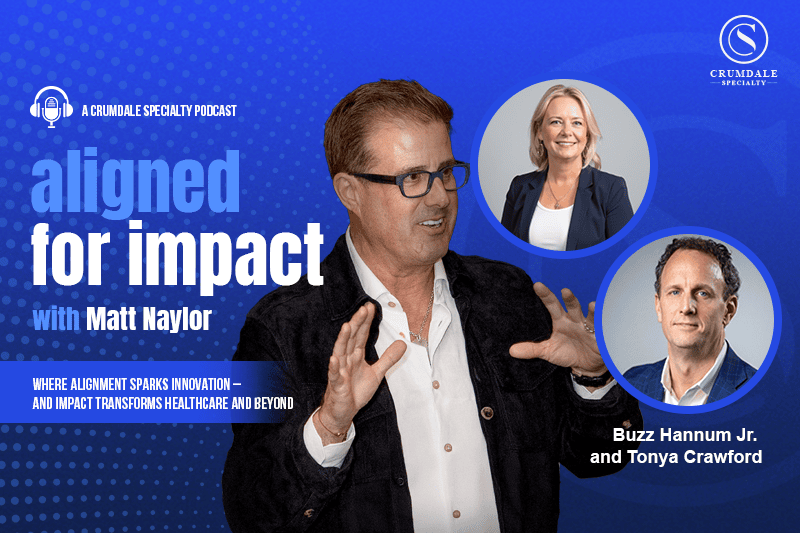
Why Most Health Plans Fail and How Captives Change the Game with Buzz Hannum Jr. and Tonya Crawford
Matt is joined by Buzz Hannum Jr. and Tonya Crawford, who share their journeys into the insurance and healthcare space and how they came together at Crumdale Specialty. Buzz started on the broker side, developing a focus on risk management and alternative financing, while Tonya transitioned from a clinical healthcare role into the business side, keeping patient outcomes at the center of her work. Together, they explain how Crumdale’s approach differs from traditional models by guiding employers through a phased transition from fully insured plans to captive solutions, using data, cost containment strategies, and integrated services to reduce costs and improve outcomes. They also highlight the importance of alignment, transparency, and partnership with brokers—positioning Crumdale as a true extension of their teams in an increasingly complex and fragmented healthcare market.
Listen on: Apple | Spotify | Amazon Music
About Aligned for Impact with Matthew Naylor
Healthcare in America is complex—and real change requires alignment.
Aligned for Impact with Matt Naylor explores what happens when vision, values, and execution come together across the ecosystem of healthcare, leadership, and business.
Hosted by entrepreneur and Crumdale founder Matt Naylor, this show brings together voices from across the industry—brokers, consultants, innovators, and leaders—who are driving better outcomes, lower costs, and improved experiences for employers and members alike.
But the conversations go beyond benefits. Matt dives into the principles of alignment that create lasting impact: emotional intelligence in leadership, trust in partnerships, purpose in culture, and a shared commitment to doing things the right way—not just the usual way.
It’s about the alignment that fuels innovation—and the impact that leaves a legacy.
Matthew Naylor: Welcome to the Matthew Miller podcast. I’m your host today. You know, it’s an awesome opportunity to talk about Crumdale Specialty. As a veteran CEO, it’s a real part of my life, my passion, my purpose. But we speak a lot about the intersection of insurance, risk financing, healthcare services, healthcare technology, and really data. So it’s an interesting thing to think about. And you two have amazing careers. know, Buzz Hannon, you’re our senior vice president of our captive business, but been with us probably for eight years now. And I’m excited for you to share your story. And Tanya Crawford, you’re our vice president of Captive Solutions, and you’ve been with us now for probably a year and half. Time flies. Yes. You know, I like to start with icebreakers. Buzz Hannon: Calling on eight years. Tonya Crawford: Eight years. Matthew Naylor: It’s just fun. It’s an easy way to start a conversation, but you both have great stories. You know, your past, kind of your present, what you’re doing with Cromdale today, but really your future opportunities, your outlook on the marketplace. And when we talk about insurance and risk financing as kind of one of the quadrants, and then we talk about healthcare services as another quadrant, we talk about cost containment as another quadrant, and then really kind of healthcare technology. I think both of you bring a lot of breadth and depth and experience to the Cromdale specialty business. And Buzz, I’d like just to start with you, if you could just help us understand a little bit about your story, where you started, how you got into the insurance business, and how you ended up with Cromdale. Buzz Hannon: Yeah, absolutely. Well, thanks for having me on, Matt. Really appreciate the opportunity to be with everybody today. So my story is, you know, as probably for a lot of people, they don’t get into insurance business on purpose. Mine was accidental as well. I had the opportunity to graduate graduate school in 2003. I met a CEO of a retail agency soon after I graduated. And he very passionately brought me into the insurance side of the business, in the insurance world, in industry, on the broker side. So I learned early on how to provide consultation, strategic advice to mid-size employers who were struggling in understanding how to manage health insurance costs as well as property and casualty costs. So my background really was started through my CEO of the retail agency and ultimately led me down the path of what is the best way to find opportunities for midsize employers to control costs and provide better risk management techniques to manage future costs. And I developed an early passion in alternative risk financing, group captives, large deductible programs, A31B captives to provide better advice and counsel for those clients. So it was a real great opportunity. I spent 13 years in that retail space, developed some great relationships with employers, captive managers, and then had the opportunity to jump into Crumbdale in 2018. And since then, I’ve been really excited about the vision that you’ve created and the path forward for us to continue on the path forward to creating better experiences for employers and better outcomes for those employees. So it’s been fun ride. Matthew Naylor: know, Buzz, as a retail broker, that is not for the faint of heart. You know, and I’m sure you recall a lot of small, mid-sized, privately run, family-owned and operated businesses and, you know, making insurance recommendations and risk financing recommendations and alternative funding recommendations. They’ll have very significant consequences. You know, what was the… For you and your experience, what was the biggest transition going from like a retail broker? And what did you learn in that process and transitioning to Crumbail specialty? What did you apply here and how has that benefited you and the organization? Buzz Hannon: Yeah, I love that question. To me, it was all about differentiation and articulating a unique story in the marketplace. So as I started my business on the retail side in 2004, it’s a very crowded space with a lot of insurance advisors, consultants calling on those companies that you just mentioned. How do you differentiate yourself compared to all the other folks that are calling on those employers and those CEOs? And to me, it was all about risk financing. It was all about risk management. And it was really all about their business. And how do we create an insurance platform that drives better P &L and really becomes a profit center for those organizations? And so again, I leveraged and utilized the captive strategy to develop a unique and differentiating talk track around ways that I could differentiate, ways our agency could differentiate and ultimately lead to better conversations for those CEOs. That transition into Crumdale was actually quite easy compared to the transition from outside insurance industry and starting in the retail business. Having sat in the broker seat, understanding how to differentiate and understanding some of the challenges and opportunities that those agents and brokers and consultants face gave me an opportunity to come in and really become a strategic advisor and consultant for those brokers and agencies today in the way that I serve with Crumbdale. And now that we’ve added in the captive solution, again, it’s just allowing us to create even a broader platform and ways that we can attract and develop really deep relationships with those brokers and their clients, which again has been a true joy. And I’m excited about where we’re going and what the future holds. Matthew Naylor: Tonya, I love your story. You’ve been with Crumdale Specialty now for a year and a half. And part of my podcast is really about Crumdale, especially when you think about the risk financing and healthcare services and cost containment and healthcare technology. But it’s also about being innovative. It’s about being creative. It’s about being disruptive. It’s about being an entrepreneur. And you have just this awesome background and experience. I’d love to just start there. Could you just tell us about how you got into the business and where you were and how you transitioned into Crumdale? Tonya Crawford: Yeah, sure. Thanks, Matt. So I think my journey into health insurance and my journey to Crumdale is a little bit different than many others. I started out in health care somewhere on the clinical side. So have an undergraduate degree and am board certified in cytotechnology, which is cancer diagnostics. Did that for 10 years in a hospital setting in Kansas. Sounds very impressive and it’s a very important job, but really it was me sitting in a hospital, in the lab, in the basement, looking in a microscope, kind of 10 hours a day. And while it was extremely important work, I knew it was something I didn’t want to do my entire life. But I very much cared about the patient. And so that’s what got me into healthcare. So I took some time off, got my MBA in healthcare administration, thought I would end up in hospital administration, ended up with an internship in Blue Cross at Blue Cross and Blue Shield of Kansas in government relations, which then led me into the insurance world and the business side of healthcare, which I have a huge passion for, but still keeping that patient, that member, that employee kind of always at the center of everything that I do. So I spent years at Blue Cross and several other health plans, had the opportunity to come to Crumbdale a year and a half ago to help stand up our captive program. What brought me here was your vision, the conversations that I had with the partners at the time. because our focus is broad, we have breadth and depth of capabilities that I think other partners in the space don’t have. I knew that we would be able to be successful specifically in CAPTIV. But also how much we care, I think our culture is different than many other carriers and the fact that the member is always at the center of everything that we do. So being able to continue to carry my values through as we deliver on our CAPTIV solution was extremely important to me. Matthew Naylor: Thank you, Tanya. Let’s talk a little bit about our operating approach, our philosophy. At Crumdale, we really talk about how do we truly create a win-win-win-win for our trading partners, a win for the brokers, consultants, and agents that we work with, a win for the employers, and a win for their members and their employees where we’re reducing costs. you know, we’re producing better outcomes and we’re creating a better experience. There’s a lot of stuff going on in healthcare today. And we all know healthcare for small employers is either their number one or number two biggest spend when they think about their operating budgets. you know, let’s, let’s talk about risk financing for a second. The risk financing component of CAPTIS is very important. And I’d like to get both of your perspectives on that piece of it. Because what we do at Crumbdale is very unique when it comes to how we optimize and manage the supply chain when you think of the total solution to an employer for a self-insured medical plan. Can you just speak to kind of your experience with risk financing and some of the things that you’ve seen and some of the things that we’re doing and why you think it’s different here at Crumdale Specialty? Buzz Hannon: Yeah, sure. I’ll start and Tanya can certainly add in and provide her a thought process around it. I’m a believer, before we go to risk financing, I’m a believer in risk transfer. I started at risk transfer level. My personal opinion is I believe less risk transfer to the insurance company and more risk management. That’s like my number one philosophy, what I did started out as a broker. I think that’s really important for employers and brokers that we work with to have the understanding of how do you develop cost containment risk management strategies that help employers transfer less to the insurance company and put more opportunity where they can have return, control, and better accountability in managing healthcare spend. That’s number one. The financing piece is number two about then now that we know what we can do from a risk management. how we’re gonna set up risk transfer, now let’s talk about how we wanna finance that risk. And the captive is a vehicle to allow us to do that better and then ultimately provide an opportunity for those employers to be with other like-minded employers that’s going to allow for that risk financing to be a advantageous position for them. So again, I start risk transfer, risk management, and then move into the conversation of risk financing. That’s just always been my belief in how I’ve set it up and had the conversations at the start. Tonya Crawford: Yeah, I very much agree, Buzz. For me, think when I’m thinking about an employer situation, it’s all about control. So if we’re in a fully insured carrier environment today, let’s say, you know, very little control. So it’s kind of moving across that continuum on their journey to self-funding. And when we get all the way to the captive model, they have more control, they have access to all their data that gives us all this powerful information. We can pull these cost containment levers. It gives them the ability to win. and to participate in the risk in a way that they can’t in any other model. So I think that that control really allows them to to manage the risk and then helps with the risk financing as well. Matthew Naylor: know, Crumdale, especially, you know, working hard, doing the right thing, really supporting the people we have the great honor to work for and serve every day is important to us. And, you know, we have a kind of a crawl walk run approach here at Crumdale and we could have gone into the captive business many, many, years ago and we decided not to. I love to get your perspective on Crumdale’s operating approach to the market, know, a small to medium-sized employer that’s fully insured and, know, kind of what we do and how we do it why we do it the way we do it. Tonya Crawford: Yeah, I think thanks, Buzz. I think we are uniquely positioned in the fact that we can really take the opportunity to understand where the employer is on their journey to self-funding. So, fully insured, we’re going to put out this long-term roadmap, which is also very beneficial for their consultant because it helps them lay out instead of year after year, we’re looking for different solutions. We’re laying out this three to five year plan in this crawl walk run approach. So, going fully insured, moving into our level funded integrated health plan year one, maybe spending some time there, getting an opportunity to feel like, what is it like to be self-insured? Getting our hands around the data. Where can we pull these cost containment levers? And then year two or year three, we have this roadmap laid out to get them all the way to self-funding, leveraging the captive model. So I think that is where we’re uniquely positioned to be able to really understand their needs and meet them where they’re at. Matthew Naylor: And Buzz, from your perspective, it feels like that’s doing the right thing for the customer. Can you, from your experience, can you explain why you think it’s doing the right thing? Buzz Hannon: Yeah, and Tanya said it very eloquently and I’ll just add in really one employer of particularly that really worked really well in practice. We had a group that is now a captive member. So they were one of our first entrants into the captive last year. Two years ago, they came into our integrated health platform on a level funded basis. Prior to them even joining our level funded integrated health platform, we identified their biggest cost driver, which was a $350,000, $400,000 medication. We ended up working with our clinical team. prior to them even joining, identifying that claim, identifying that member, working with clinical, we eventually found a solution through one of our alternative sourcing mechanisms, saved that client roughly around $250,000 to $300,000. That individual is now getting that medication at no cost. So we set it up stage one, which is sort of the crawl approach, put them a level funded, create the access, create better data. And as soon as they realized the opportunity that they were getting through that level funded program through Crumbdale, we then were able to get that data, have a more in-depth conversation about the next stage and the next step in their healthcare or management of healthcare journey, which was then through the captive. So in practice that created a win for the broker, because now we’ve identified an opportunity for them to be a better consultant and advisor based on the data. The employer saves significant amount of money, again, just for that one claim was close to $250,000. And that member who is still working with our team on the patient assistance program is getting that medication at zero cost. So again, when you talk about sort of that four prong and the four win approach, again, that opportunity is real. And again, that’s just a prime example of what we’ve accomplished. Matthew Naylor: Yeah, so you have a, in the real world, you have a small employer, 50, maybe 150 employees. They’re fully insured to privately run business. owned by a family. It’s one generation, two generations, three generations. You have very limited data. You could be insured with United, Aetna, Cigna, Blue Cross. They’re all very good companies. But with no data, there’s lots of people in the market that will take a fully insured customer right into a true self-funded solution with no data. and then move them from a blue cross where they have like a ID card, they show up and they see a provider and they get a bill paid and easy peasy into a solution that is, you know, unbundled, confusing for the employer from a risk financing perspective, confusing to the member from an experience perspective, and then no data to deal with understanding what the frequency or severity of claims are. You know, so I think our operating approach is very different and it’s very member and employer centric. It’s can we do the right thing? Can we be responsible and put them in the right risk financing vehicle for where they are at the moment? And I think Buzz, your story that you just shared is a really a wonderful, wonderful story. You know, one of the things that I think we do differently at Crumbdown, I’d love for you to speak to it a little bit, is there are captive providers that sit within parts of the ecosystem, parts of the supply chain. know, risk financing, insurance companies, stop-loss underwriters, MGU’s, program managers, healthcare service providers, TPAs, PBMs, cost containment providers, know, bundled payments, high performing networks, MSK, you know, solutions that are trying to find ways to reduce costs from a cost containment perspective, and then data. Technology, whether it’s a VeriKai, it’s a SpringBuck, it’s a DeerWalk. There are many solutions in the marketplace, but there are very few that have a true high-performing solution where they’ve optimized everything, they’ve integrated everything, they’ve made it easy for the employer to understand risk financing, they’ve made it easy for the broker to… bring the solution to the marketplace in a very agnostic but transparent way. And they’ve been very easy for the member to experience and engage in consuming insurance. Can you speak from your experience what you’ve seen in the marketplace and how Crumdale is different? Buzz Hannon: Yeah, again, I’ll start and Tanya can chime in. And this is probably number one on Tanya and my list as far as most passionate about of what we’ve created in that high performance captive compared to what has been going on in the marketplace and what’s happening today. The opportunity for an ecosystem to be created, it creates a full blueprint where we’ve attached cost containment, risk management strategies that deliver the results that I just talked about. for each and every member that comes into that high performance captive. In the past, again, Tanya’s got a ton of experience in seeing what’s going on out in the CAPTIS space and having worked in CAPTIS before, where it was more of freedom of flexibility, medical stop loss here, transferring the risk, but really not necessarily identifying and focusing in on what’s really driving the cost, right? What’s driving the continued increases for those employers, just moving into a captive doesn’t solve that. It helps, and now you’ve got a vehicle and you’re surrounded by other like-minded employers, but if you’re not attacking and developing the strategies necessary and what’s going on at the claims, because it is all about the claims and managing those, you’re not really creating the better path forward. And I think what we’ve done really, really well And purposeful, and you’re right, we could have been in a captive business when I started seven, eight years ago. And I love the fact that we’ve created this underwriting success with our underwriting partners. And now we’re in a position to really have a captive platform and program that is unique and that creates a better opportunity for employers based upon how we’re managing and bringing better cost containment strategies to that ecosystem at the plan level. That is far different than what’s been going on out in the marketplace. And that’s why I think Tani and I share that same passion about what’s going to be happening for us in the future and the abilities that we’re going to be able to bring to the broker community and their clients with the high performance captive. Tonya Crawford: Yeah, what I’ve seen in the past and other captives or self-funding in specifically is that it can be a very disjointed experience, really hard on the employer, hard on the consultant, very hard on the employee. That group that you just referenced, you know, that 50 or 150 life group going from fully insured, putting them directly into a captive, no data, that can be a very unsettling and unhappy experience and I’ve seen that in the past. So, what we’ve done with our integrated health program is made that easy, seamless turnkey. So that’s what I often refer to as our easy button for captive. But because it’s everything integrated into one package, so rebundling the self-funded experience. And as they move along that continuum, like Buzz mentioned, the case study that we have, the group that started out in level funding, moving into our captive program, zero disruption for the employer, zero disruption for the employee as they move along that continuum. Everything has stayed the same once they got into the Crumbdale ecosystem. So I think that’s a true differentiator for us and again helps us with that long-term strategy for that employer and just makes it easy. Matthew Naylor: Tanya, thank you for sharing that with us and me. Driving to the lowest cost sometimes can be invasive and very disruptive to an employer and to their employees. And most small businesses, their most important asset is their team. So when you think about the way we integrate things and we’re driving to the lowest net cost, The marketplace for the most part on the captive business is really about insurance and risk financing. And they tend to take a very agnostic approach to how things are being managed when it comes to healthcare services, when it comes to cost containment, and when it comes to the data. And Crumdale’s operating approach is very different than that. I just wonder from your experience and perspective, that level of integration, you know, when you think of a broker that would work with a Crumdale that brings, you know, 10 or 15 employer groups from maybe same industries or different industries, you know, into a captive, it just boggles my mind sometimes when I think about risk financing and others in the marketplace allowing, you know, all those employers to have a different TPA, to have a different PBM, to have a different set of cost containment tools, to have a different structure around their plan documents and contract terms and conditions. Can you speak to the level of integration that we have here at Crumdale Specialty and how it actually drives to a lower cost in a non disruptive way and produces a better outcome? Tonya Crawford: Yeah, I think when you talk about those other captive models out there where everyone’s kind of doing different things, I think it’s hard to have optimal performance in that captive program. So kind of going back to the data and our take on data at Crumdale, I think is a very holistic approach. And that is very different than the other captives in the market who maybe only care about hits to the captive, hits to the stock loss layer, those high claims. We’re not really paying attention to what’s going on in that employer self-funded layer. we take a very holistic view when it comes to data and we’re looking at all the claims that are coming through. I think that’s so powerful because that is where we can get ahead of our high cost claims. We can get ahead of our population health drivers. If we have high instance of pre-diabetes in a population, we want to know about that early on. Those are our heart attacks waiting to happen. Those are our million dollar claims waiting to happen. So I think our approach to data is very different than what we see. One other thing that I think is very different than some of the other captive approaches kind of going back to managing that self-funding experience is our member advocacy. I think it’s critical in self-funding because it can be so disjointed. So the fact that we have built-in member advocates in all of our plans so that members can directly call Crumdale advocates sitting here in our Philadelphia office, they’re Crumdale employees, guiding members to right care, right time, right place, helping them understand their benefits I think is critical and a huge differentiator compared to anything else in the market. Buzz Hannon: Again, I call it the blueprint and the blueprint that has been created and the vision that Crumbdale and really Matt that you put together early on and transitioning that into the captive. Again, that is far different than what has been going on in the marketplace and Tani spoke to it. I think left-hand and right-hand are talking to one another, advocacy, speaking to employees, we’re getting the feedback and the results from the cost containment that’s built in and ultimately what does that lead to? That leads to better underwriting success, which as a whole, better performance for the captive and individually better performance for each group. So that’s really what we focused on is creating that blueprint that’s going to allow for equal opportunity for each group, regardless of where they’re coming from. They’re all going to have those same elements and pieces together, minimize the disruption, create a better experience, really advocate on from both a medical and a pharmacy standpoint. and again lead to better productivity, better integrity, and ultimately better results within the gap. Matthew Naylor: You know, we have an interesting model when it comes to distribution. And I’d to get your perspective on it. We believe in a very immersive learning process here at Crumdale Specialty, both internally and externally. And we really look to partner with the right set of brokers, consultants, and agents that truly want to do the right thing for the customer, serve the client the right way. That’s not an easy thing to do. Can you talk a little bit about our immersive learning process internally, externally, and then a little bit about our limited distribution and how we like to partner with people? Buzz Hannon: Yeah, so let me take the limited distribution piece first. Again, that is something that I’m very passionate about. know Tanya has been joining us about a year and a half ago. I’m very passionate about it as well. Again, that is very purposeful about the relationships that we set up with each broker firm, philosophical alignment, understanding how we can truly create engagement that’s going to lead to success. Not only for us, And for them, but more importantly for their employer groups and for their members that they serve, we have the same thought process about innovation, about creating better opportunity and experiences for those employer groups. And that alignment with each of those brokerage firms is critical. It’s critical. And we take them through a pretty detailed process in order for them to become part of that distribution. And what that really does is allow them to get to know us. We really get to understand where they’re headed. what their goals and objectives are, and how do we find connection together? And I think that’s been a major piece to our success is creating that right alignment engagement with each of our brokerage firms and that preferred and limited distribution. So I’ll start there. I think that’s, again, sets the process up first and foremost. Tonya Crawford: Yeah, and I’ll speak to our learning and development program. Another thing that kind of blew me away when I joined Crumdale was that as a new employee, everyone comes on site in Philadelphia and spends a week just immersed in all things. Crumdale Insurance, a lot of people come from outside the industry and they have no idea what a deductible is or co-insurance or stop loss. So that is something that completely sets us apart from any other job I’ve had in the past. And then just to see how that has progressed, the investment that we’ve made as a company in learning and development. It’s not just for our employees, it’s for our preferred broker partners. It’s for our employer clients. It’s for our captive members. Just helping them understand all of these different terms. Insurance is so complicated. When I got into insurance, I was like, there’s so many acronyms. This is so confusing. And then as I progressed in my career from the carry model to self-funded model and then captive, at captive, we’re at the far end of complexity here. So I think we do a really good job of making it understandable, consumable, and sharing that out. think education is so important and a big part of what we do here. Matthew Naylor: what I love talking about when I do these interviews. It’s not just about Crumdale Specialty and where we sit in the intersection of employee benefits and self-insured medical plans as a real hub and a unique and distinctive business, but it’s about being innovative and creative and disruptive. But I think most importantly, it’s about living a life where you have real passion, real purpose. you’re making a real difference in people’s lives and ultimately meaningful impact. In a buzz, Tanya, I’d like to ask you the same question. Why is your work here at Cromdale so impactful to you personally? Tonya Crawford: Sure! Yeah, I’ll start. Couple of things. So, you know, I started kind of talking about my career, putting that patient at the center. I think that at Crumbdale, we do the right thing and we do it for the member. We do it for the employer and we do it for our broker partners. So maintaining that integrity is extremely important to me. Matthew Naylor: the culture, the team, the people, how has that impacted you? Tonya Crawford: I was talking to someone recently who we would like to come work for us and who’s very experienced and, you know, she’s kind of trying to feel out her opportunities and she’s like, well, what’s it like to work at Crumbdale? was like, it is the most fun job I’ve ever had. And it’s fast paced, it’s innovative, it’s entrepreneurial, but it also feels like family. I mean, we very much care about each other here. We support each other, we support the community. But in the initiatives that I’m involved in, that I’m pushing forward, The executive support is like nothing I’ve had in my past before. And so to have that and to know that we can really make an impact and that we have an executive team behind us allowing us to do that has been just very fulfilling. Matthew Naylor: That’s awesome. Buzz Hannon: Yeah, again, I’ve been fortunate enough to be here almost eight years. So I’ve seen a lot of growth within the organization. It’s been pretty exciting to be a part of that. Since I started here in 2018, I think what the, what the coolest thing is about what we do every day is the, the fact that when, when I started Matt, were eight, 10 people max in 2018. We’re now 170 people across the entire organization. in the fact that the passion is throughout the organization. And what I’m talking about is I’m on the sales side. I love winning. I love obviously getting new groups in, new broker relationships. But what gets me out of bed every morning is the fact that the team and the passion and the commitment amongst everybody in that organization is it’s across the entire employee base. And that is a complete attribute and a testament to you and the executive team when starting the organization and sort of the passion that you guys created early on and the importance of that. Cause I agree with everything that Tanya said. Like I love, you know, when we get an employer group and we have a result in the one that I talked about where we save them hundreds of thousands of dollars, where there’s a member that we’ve created a better channel for them to access care. All of that is like unbelievable, like makes me so satisfied and rewarding, but really it’s about the team internally and the passion and commitment that each of them have to roll up their sleeves. Are we perfect? Absolutely not, but we strive for it every day. And I can tell you the team members are willing to roll up their sleeves and figure out a better way. How do we become more efficient? How do we communicate better with our brokers and continue to develop on the learning development side, better ways to connect with our members through our advocacy programs. It continues to just build upon itself. super excited about where we are, where we’ve come from for sure, and most importantly about where we’re going. Matthew Naylor: That’s great. Thank you, Buzz and Tanya. The brokerage community, retail brokers, consultants and agents, they see a lot of things. There’s just a ton of stuff coming into the market. What are you hearing? What are you learning in your travels? Both of you travel all over the country. You’re in meetings 24-7. I’m just wondering from your perspective, in your travels, what’s most important to the brokers and the agents and the consultants? What are they looking for? What are they missing? What are their issues? What are their challenges? Buzz Hannon: It’s a great question. I don’t know if I have all the answers to that question, but I can tell you what I hear is it is a very fragmented, noisy, complicated market for the brokers. Again, the ones that we work with strive every day to do the right thing for their employer groups. And in some cases, it’s very difficult because of all the point solutions, all the calls that they’re getting. the new shiny objects that’s going, you know, delivering into their face about what is the right move and what’s the right opportunity. And they only have so much time in their day to vet all of these programs out. I think again, where we’re uniquely positioned and to support these brokers is we take a lot of that work off of their plate for them. We’re vetting out these solutions every day. I know you’re involved in, you know, new TPAs, new PBMs, new point solution, new cost containment programs. that we evaluate every day. We leverage our experience and expertise for the folks that we have here to figure out which ones make a lot of sense and which ones don’t necessarily make so much sense. And then how do we funnel that, aggregate that knowledge and bring that out to better solutions for our broker partners? I think that’s what I’m learning as I continue to have these conversations that there’s more of a need for that. finding folks like Crumbdale to bring those solutions in a much more efficient manner that creates the power of expertise and aggregation and the muscle that we have in the marketplace to deliver better results and better connectivity for those brokers. Tonya Crawford: Yeah, 100%. I think they’re overwhelmed by the point solutions in the market and trying to find the time to vet those. So think when they work with Crumbdale, you know, we often say that you can look at us as an extension of your team. You know, we’re doing that work for you. We’re taking some of that lift off of your plate and allowing us to kind of integrate it into our model, find those best in class solutions and make it easy for you to implement. Again, kind of going back to that turnkey model that we operate on. I think that they’re looking for partners like that that make their jobs easier and still know they are operating with the highest level of integrity, doing the best thing for their client, do the best thing for their employees. Matthew Naylor: Yeah, it’s really hard for brokers to really think about how do they manage all that in a way that’s truly unbundled. You know, because you’re dealing with a TPA, you’re dealing with a PBM, then you’re dealing with cost containment, and then you’re dealing with data and analytics, and then you’re dealing with risk and risk financing and risk transfer. You know, what I think is so interesting about Crumdale is our ability to do all that in a very transparent way where there’s real oversight and ability to look at fraud, waste and abuse, audit real check registers and claims, doing it in a way that’s interfering with the member’s experience, doing it in a way that’s very member-centric, but in a way that makes it easy for the broker to understand, easy for the employer to understand and still get to the lowest cost. Transparency is a big thing for us here at Grumdale. And being able to steer people to the best providers at the lowest cost is also a big thing for us. Can you just speak to transparency a little bit and how we run our process? Buzz Hannon: Yeah, it’s I mean, again, it’s something that we’re we’re very passionate about and providing that clarity and transparency in all the things that we do, whether it’s in our relationships and our contracts on the pharmacy side, whether it’s, you know, truly transparency on how the data and what the data is, is showing us to provide better, unique conversations and solutions that are available into the marketplace. So again, it’s What I find about that word transparency, it’s overused in the marketplace, but I feel like it’s underused in the way that we utilize it here at Crumbdale, because it is extremely important for our brokers to truly understand, again, a little bit how the sausage is made, and again, how to better educate their clients in finding the right solutions that are going to make the most sense to them. So again, that totally is a big part of what we do. how we create that engagement with the brokers and truly understanding where we’re going to bring the value. And that really is around transparency. Tonya Crawford: Yeah, and I think again about our data approach, this holistic approach that we take to looking at our data. So that’s transparency and data, which you can get in other self-funded health plans, but you have to work with a partner that helps you understand that data, packages it up for you and says, this is what it means. These are the recommendations that we make from a risk management, from a cost containment perspective. I think that’s rare in this market. So I think we take a completely different approach there. And that allows us to do really powerful things when it comes to reducing the cost of claims. And then we kind of talked about payment integrity, know, reviewing all of our claims over a certain dollar threshold. I think also that is unique in the space. We’re not looking to upset provider networks. We’re not looking to, you know, have problems with contract pricing. We’re looking for fraud, waste and abuse. So things that truly should not be in the claim. Backed up by American Medical Association, American Hospital Association guidelines. That’s us being a good partner. good financial stewards, specifically when it comes to the captive, I think that is part of our responsibility as the captive program manager for those employers that are participating. Matthew Naylor: You know, a lot of people talk about fiduciary responsibility today in the marketplace. A lot of consultants and agents is getting a lot of attention, you know, transparency and fiduciary responsibility at the legislative level. There’s been a lot of scrutiny on PBMs, you know, and other parts of the healthcare ecosystem. It’s interesting to me that, you know, we have taken approach where we’re really trying to manage all the data in a very integrated way so that we can help our self-insured captive customers be the best fiduciaries that they can possibly be. There’s a lot of shiny objects in the business. There’s lots of things that happen in a self-funded medical plan. I like to refer to them as bait and switch. know, recap into new laser contracts or, you know, uh, TPA and ASO credits for, you know, PBM rebates and all kinds of like funny things that go on in the market that actually aren’t in the best interest of the customer. You know, we, we, um, we have a really pretty robust compliance business that it’s fully integrated into our captive solution. where we’re not outsourcing to others. And we take our duty and responsibility around, we’re not a fiduciary, but we take that duty and responsibility on behalf of our customers to provide them the best level of service so they can make the best possible decisions as a fiduciary. And there’s lots of people in the market that talk about plan-wide discounts. And again, I’m not picking on anybody because I think there’s lots of great insurance companies out there. But when you get a 75 % discount off of a bill charged that’s inflated by 400 % or a rebate on a drug that is also inflated by 400 or 500%, being a real good fiduciary is a really difficult thing to do. I think we do it in a pretty unique way. Can you speak that out a little bit? Tonya Crawford: So I think in many of the models that are out there today, there’s a lot of vertical integration that’s happening. so incentives are not aligned. And so that goes back to our kind of a premise of how you started Crumdale Specialty is about how we align incentives, how we align ourselves with our preferred broker partners, how we align ourselves with the employer, how we take a risk position on our level of funded business. That does not exist in the carrier model where we have. Carriers owning PBMs, PBMs having partnerships with TPAs or owning TPAs. And I think that creates a lot of conflict. It’s hard to do what’s in the best interest for the employer when you have that type of vertical integration. Buzz Hannon: Yeah, so again, it’s the proverbial fox watching the hen house and not necessarily in the best interest of what really is for each organization. I love your example of, you know, admin fee credits, certain things in contract language that prevent or allow for all sorts of maneuvering and shell games to occur. Again, there are a lot of great solutions out in the marketplace. And we, again, we see them every day. But it’s really about creating that, if you want to call it fiduciary responsibility, I like to talk through it. think Tani mentioned alignment, right? And it’s creating more alignment with employer, employee, broker, and Crumbdale or service provider or solution provider, however you want to list it. All of those pieces being connected to make sure we’re doing what is best for the employer and the member. That’s what we’re passionate about. That’s what we do. And I think in historical perspective has shown that’s not always the case with every solution provider. And I think we’ve stripped that out, created better clarity and allow for again, a little bit more view and understanding really what’s going on and that we’re going to be right there with them to figure out what’s going to be the best solution so that they can get on the right path or continue on the right path. And again, create a better experience long term for those members. Matthew Naylor: You know, we pride ourselves on being innovative, creative, disruptive, and flexible. I think flexibility is an important thing. You know, we don’t have just one captive solution, we have a few. And there’s good reasons for that. Could you just speak to flexibility a little bit? Buzz Hannon: I’m going to change your word again. I’m sorry to do that. I’m going to use the word agnostic. again, I think we are flexible. We don’t like do everything in all things, but we’re agnostic. What we’re looking for is what is the employer looking for? What are the members need? And how do we find the best solution for that? And we truly are agnostic. So whether it is, and I’ll speak specifically in the captive, because again, that’s what Tanya and I are so passionate about, but The high performance captive allows for that ecosystem to already be built, the cost containment strategies to be attached. Great solution, I think very unique as we’ve already talked about in the marketplace. But we have the opportunity to have what we call our open captive, your traditional medical stop loss captive, which allows for more flexibility and agnostic selection about, well, you know what, I need this particular network solution because of X, Y, and Z. Or I need this particular pharmacy solution because of X, Y, and Z. As long as we all understand that and what’s going to be the best solution and that is going to be the best solution for the client, again, we’re agnostic. Let’s figure that out together in partnership and with the right engagement. So from our standpoint, again, and Tonya and I with our team, with the brokers that we work with, it allows us to be so much more consultative and strategic than here’s our solution. How do we fit it in the box? No, no. The box can be, again, we have limitations, but the box can ultimately be created in what is the right decision and the right move for the client. Matthew Naylor: So Buzz, if a broker has developed a high performing narrow network in a market or a broker has developed something that delivers some type of direct primary care in a market, or they’ve built a solution that is actually helping to reduce cost and produce a better outcome. Buzz Hannon: 100%. Matthew Naylor: I assume those are the types of things that fit in well with our agnostic approach. Okay. You know, the other thing that I hear us talk about a lot at Crumdale is how risk financing is highly commoditized, stop loss. And risk transfer is not really, it’s a complicated subject, Tanya. And people don’t spend enough time on like, what does the plan document say? What is the actual stop loss policy say and what does the actual PBM agreement contract say? And those three levers seem to me like they’re three large drivers of what ultimately is going to happen when you think about risk financing. Can you talk a little bit about our open captive and how we weave those three things together in the best interest of the broker and ultimately the customer? Tonya Crawford: for sure. So it’s important for us to have eyes on those contracts so that we can make sure that we again are all doing the right things for the captive for the long term solvency and stability of the captive. But but rather than us just handing over a 60 page document for the employer to sign, we are going to take a consultative approach. And I think that’s what’s different is that we have this team, you you spoke about our compliance and actuary team that is a big part of the captive. and helping us take a look at those contracts, making consultative or strategic advice if we need to make some type of changes there, but doing it in partnership. So not just leaving that on the broker’s shoulders or not just leaving that on the employer’s shoulders. We’re really here to be that partner, that strategic guidance to help you understand what these pieces mean and where they fit into the overall strategy of the captive. Matthew Naylor: That’s awesome. Guys, what did I not ask you that would you wanted me to ask you? And you can take a second and think about it. Tonya Crawford: So specific to the outlook, I think for captive, there’s a lot of players in the space right now, right? There’s startups, there’s players that have been around for eight, 10 years. One of the reasons I joined Crumdale and why I continue to stay and I’m very bullish about the success that Crumdale will have in the captive space is because we aren’t just a captive. We aren’t just a captive manager. We are also health plan, an integrated health plan, a level funded, PBM, compliance and actuary, all of those things. We have this breadth and depth of capabilities that no other captive manager has in this space. And that is why I know we’re going to be so successful with our captive programs and why I’m really excited about it. Matthew Naylor: That’s awesome, Tonya. The other thing is I think what you’re saying is that also translate to really great broker partners. You know, because when you’re able to work with – this is what I hear you saying, but when you’re able to work with a broker not as a point solution provider, not as a risk financing transfer company or a program manager, not as a healthcare service provider or healthcare technology company or a cost containment company, you know, we’re coming as a true solution provider to our brokers, consultants and agents in a very, very robust way. All with an eye towards this optimization and supply chain management so that we can make their lives easier, make the broker’s life easier, make the employer’s life easier. I love what you guys do every day because I see it when you’re interacting with brokers and I see how complicated their lives have become. Most brokers work twice as hard now as they did 20 years ago, and they make like 20 % less or 30 % less because the marketplace has changed. Their customers are asking them to do more for less money. And then innovation is happening at the same time. So not only is the client asking them to do more administrative work, more around data and analytics, more around customer service and account management. They’re also asking them to the same time to be innovative and creative and be out in the market and see what is becoming transformational. And brokers are trying to, one, protect their business. And the other thing, like, protect and preserve their business. But they’re also trying to grow their business. I’d to get from your two perspectives, like, how do we help brokers protect their books of business? And then how do we help brokers, consultants and agents grow their business? I think those are two interesting inflection points and two things that we as an organization do pretty well. Buzz Hannon: Yeah, so I mean, I’ll start, but the protection side, again, based upon what we do and our distribution and how we connect and engage with our preferred partners really allows them to come onto our platform, get the opportunity for current clients to really experience what we do and why it’s different and to create an opportunity where we’re not talking to every broker. We’re not working with every broker in their market. And they can truly create a really sort of enhanced relationship with us that allows them to protect their business. And then once we get an understanding of how their clients work, how they work, build on that block of business, now we can actually partner together and create organic growth opportunities. when I talked about earlier, this differentiation that they’re looking for, right? It’s not a me too conversation. It’s now if we… have something that is different. We do something that is very different in partnership with Crumdale that leads to better results. And here’s that historical perspective of what we’ve accomplished and how this for new employers could be a great way for them to continue to grow organically. Matthew Naylor: So what I hear you saying, Buzz, is like we don’t behave like an insurance company. We don’t behave like a program manager where, you know, we’re sitting on one side of the table and the broker is sitting on the opposite side of the table. And then we’re trying to wedge ourselves in there between the broker and the customer. We’re really what I hear you saying is we’re really sitting on the side of the table of the broker and trying to find ways to help that broker keep their enforced book of business or block, and also really more importantly, help them grow their business. Buzz Hannon: Yeah, completely. Tonya Crawford: I think the word is partnership. So, we are not a point solution. I think we’re not even a trading partner. I think we are true partners with the broker, with the consultant. And it’s about allowing us to work together, to be strategic, to serve up the right solutions for their employer clients in a long-term capacity. So, laying out that roadmap again, looking at all of the different options that we have to serve on the table and saying what’s the plan look like in years two, three, five and beyond. Matthew Naylor: Tanya and Buzz, I’ve loved this conversation. I love to have more of them with you. What I love about it is Crumbdale specialty is a talent first, people first, culture first company. And it’s very obvious here in this conversation, like your passion, your purpose, like what brings you happiness and joy and your impact is you can feel it. It’s almost like a vibe. in what you’re saying. And myself and everybody at Crumbdale really, really appreciate what you do for us, but more importantly, for our clients and our broker partners all the time. So thank you very much.